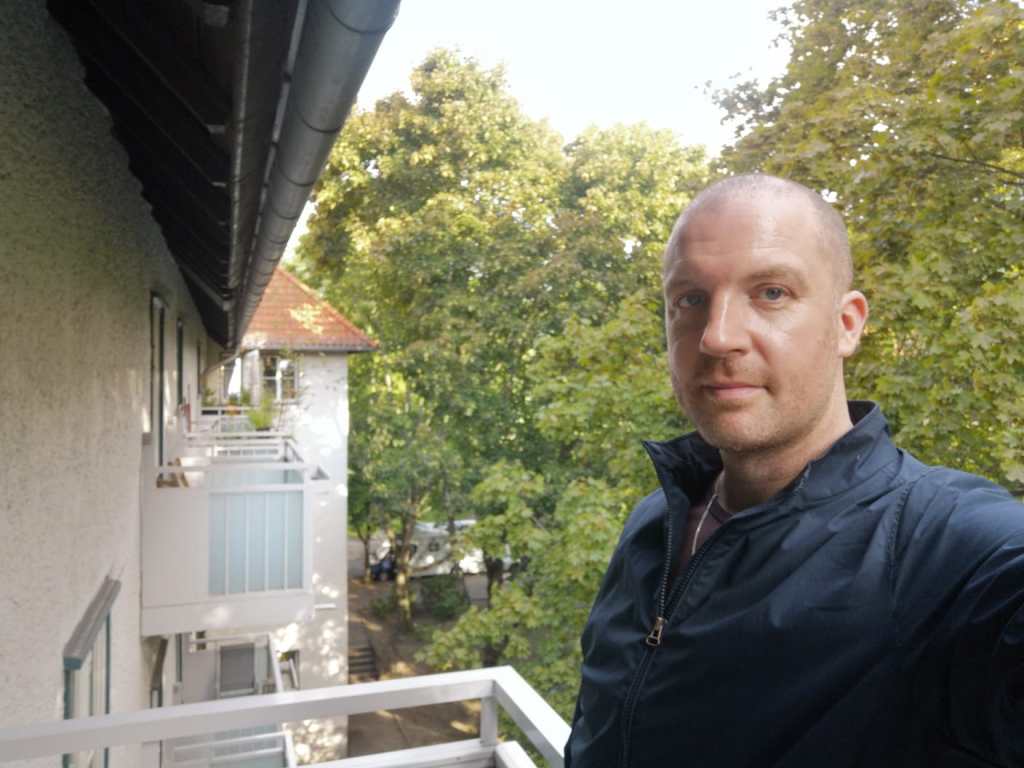
I’m Daniel Spence Agnew, a London-based content architect specialising in AI visibility and editorial systems. I’ve designed Gemini prompts for Google, built GEO playbooks for Namecheap and Spaceship, and created persona research decks and Claude Projects that cover cognitive psychology, localisation, and accessibility.
The work below shows how I think. If it makes you want to talk, I’m easy to find.
Table of contents
- Google: Early prompt design for business and education
- Google: Nano Banana Pro image prompts
- Namecheap and Spaceship: GEO playbook
- Namecheap and Spaceship: FastVPN personas and canonical prompts
- Namecheap and Spaceship: UX landing pages, blogs, and Claude Projects
- JustAnswer: Conversational analysis with Whisper
- Let’s talk
What does prompt design for Google Gemini look like?
Google hired me through YunoJuno to design Gemini prompts for Gen Z and EMEA audiences across business and education, showcasing the platform to journalists, PR teams, and retail users.
Following Google’s persona, task, context, and format methodology, I designed prompt packs across business and education verticals, including lesson plans for a local school that helped Year 5 teachers explain physics, geography, and orienteering through field trips.
💬I’m a Year 5 teacher. Summarise how the four seasons affect change in Nonsuch Park for my 10-year-old pupils in a detailed comparison table sheet and a 10-question quiz about seasonal changes in the park. Identify and describe the key visual changes in flora (including specific tree species and flowering plants), fauna (focusing on birds, insects, and small mammals), and overall landscape appearance. Include an interactive month-by-month timeline of the year in Nonsuch Park.
By late 2025, Google brought me back. This time for image prompts on Nano Banana Pro.
What is Nano Banana Pro, and how did I design image prompts for it?
Nano Banana Pro is a studio-level image generation and editing model on Gemini. With this tool, I built prompts across pop culture, sport, food, and travel, specifying camera angles, lighting, and strict ‘no logos or readable text’ guardrails.
The Year in Search project celebrated and showcased Google Search trends from 2025 for a Gen Z EMEA audience.
Nano Banana requires scene-setting and rigorous iteration to get right. This project often involved transforming a stock reference image into AI-generated scenes.
The example below is an adapted version of the original using a licensed stock image (SolStock) as the portrait source, not myself.
💬 Create a messy, photo-realistic image of me in Lisbon holding a sign. Keep my face realistic. I’m standing at the famous miradouro viewpoint in Graca, which lies above the city, with the castelo, Tejo river, and terracotta rooftops in the distance. I’m holding a large cardboard sign at chest height facing the camera, with a weather worn card saying ‘Year in Search 2025’ in Google Sans font.
Around me, show classic Lisbon details that aren’t perfect: patterned tiles underfoot, a slightly scuffed stone wall, a takeaway coffee cup on the ground, a tote bag slumped by my feet and a few other tourists in the background leaning on the railings, slightly blurred. Use warm, golden hour light with a bit of haze, soft shadows and fine grain so it feels like a real 2025 travel snap, not a postcard. No logos anywhere in the image, including on the sign.
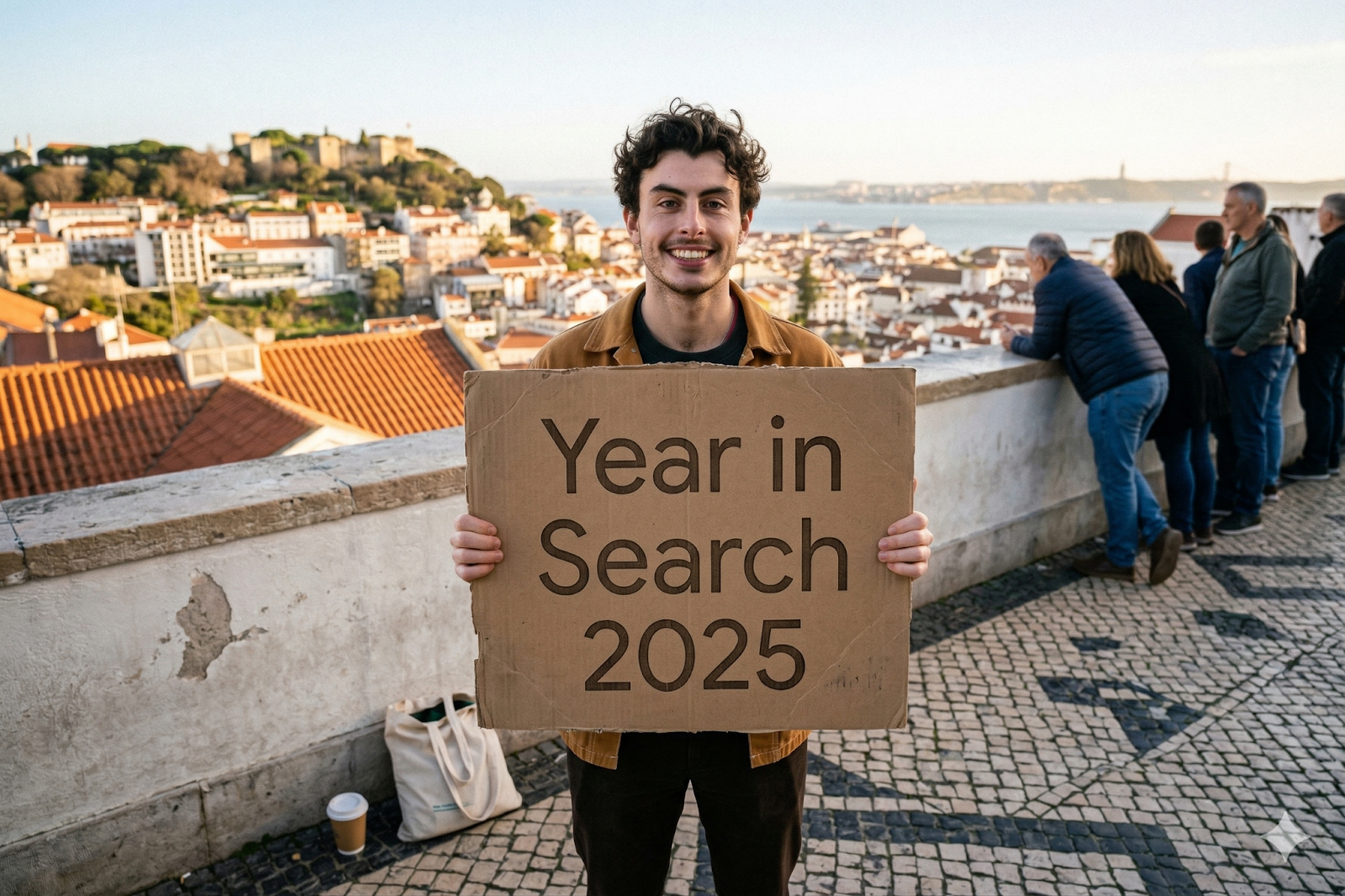
Note: Nano Banana Pro image uses a base UK male image (SolStock / ID: 1328506141) licensed from SolStock for illustrative purposes.
How do you optimise content for AI platforms for two global brands?
As a senior copywriter for Namecheap and Spaceship, I build content systems and guides for AI-powered search, including GEO playbooks, persona and canonical prompt libraries, and Claude Projects that augment brand guidelines with data-driven research, analytics, and interactive tools.
What is the Namecheap and Spaceship GEO playbook?
Namecheap and Spaceship are popular domain registrars with over 11 million customers.
Generative-Engine Optimisation (GEO) involves shaping every content headline, sentence and statistic so AI platforms can parse it, credit Namecheap or Spaceship as the source, and influence customer behaviour before they arrive.
I wrote the GEO playbook for Namecheap and Spaceship. It explains how AI platforms choose which content to cite and gives writers a reliable method for earning citations.
Unlike traditional search, AI platforms provide people with personalised, multi-source answers by parsing and synthesising content from authoritative brands and news sources.
I distilled GEO into four repeatable cues with the following recommendations:
- Lead landing pages with a clear 2-to-3-sentence “quick answer” that resolves the H1 question (~35–70 words)
- Craft H1 headers as a precise, searchable question
- Prove every blog-based claim you make with links to authoritative sources after each quotable statistic
- Flag your quick answer with JSON speakable markup so voice assistants can read it aloud
These cues give writers a repeatable method for structuring content that AI platforms can parse, cite, and attribute to Namecheap or Spaceship as the source, turning every landing page and blog into a citation surface.
I mapped how each major AI platform selects and cites content, covering Google AI Overviews, ChatGPT, Gemini, Claude, Perplexity, and Copilot. The full comparison is here: AI platforms comparison table.
How did I build evidence-based personas for FastVPN?
FastVPN is a budget-friendly virtual private network (VPN) service, available to download on Namecheap and Spaceship.
Most people accept that FastVPN users are motivated by price. I wanted to go further and build evidence-based personas that pinpoint who our customers are, where they live, and what frustrates them. So every content decision is backed by research, not opinions.
When someone challenges a content decision, you don’t defend a feeling. You point to your research.
Identifying FastVPN’s core users
Namecheap’s audience is 67% male, with 25-34 as the dominant age bracket. Leading traffic countries are the US, India, and Pakistan. (Similarweb, December 2025)
- The global VPN market tells a similar story with 54% male.
- Nearly 40% of Americans aged 18-29 use a VPN
- Over half of VPN users globally use free services only. Price isn’t just a factor, it’s the deciding factor
With this information, I used ChatGPT’s deep research feature and Perplexity Pro to trawl forums, reviews, and community posts, surfacing user language, pain points, and behavioural patterns for “FastVPN” usage.
It revealed that FastVPN users are:
- Mostly men in their 20s and 30s
- They are not wealthy. Lots of students, junior office workers, call centre staff, and low-wage agency workers
- A smaller group of remote workers, who could pay more for Nord or ExpressVPN, but choose FastVPN because it’s “good enough”
Creating FastVPN personas with Claude
I created four Google Sheet templates covering a 90-day window (Sept to Dec ’25) and populated them with customer service data:
- Google Search Console (GSC) queries
- Namecheap live chat transcripts
- Social media and app store reviews
- Internal search queries and FAQs
Sharing this information and the deep research results, I prompted Claude to generate five customer personas for FastVPN, with a percentage weighting and demographic profile.
FastVPN persona example: Jordan Miller

US budget buyer. ~30% segment of FastVPN’s personas
- Male, 29, Ohio. Blue collar field technician for a cable ISP.
- Owns an Android phone, cheap Windows laptop, and a shared smart TV.
- He wants one cheap VPN for the whole household.
- Streams Netflix shows and live sports.
- Doesn’t care about protocols or features. Cares about price, whether it works, and the renewal costs.
- Jordan wants simple deals delivered in accessible language.
Building a canonical prompt library
While personas define who your customers are, canonical prompts reveal what they ask.
Using the personas and Google Sheet datasets, I asked Claude to generate fictional but evidence-based queries, anticipating the problems each persona would ask an AI platform to solve, written as they would type them in real life.
This project became the FastVPN canonical prompt library, covering three prompt types:
- Generic (no brand mentioned)
- Branded (FastVPN by name)
- Troubleshooting (something’s broken)
What Jordan Miller types into ChatGPT
Once you know who Jordan is (age, income, devices, frustrations, and how he talks) you can build the prompts he’d write.
- Generic: “whats the cheapest vpn that works for streaming”
- Branded: “is fastvpn any good or is it one of those ones that jacks the price up after year one”
- Troubleshooting: “fastvpn keeps buffering on my fire stick. is it the server or do i need to change something”
None of these would show up in keyword research. But when Jordan Miller asks ChatGPT for a cheap streaming VPN, the content is already structured to answer him in his own language.
What UX and marketing copy do I produce day to day?
For Namecheap and Spaceship, I write and edit UX landing pages, CRM emails, newsletters, and blogs across both brands. To raise the standard of our copy at scale, I built two Claude Projects that act as editorial infrastructure.
- Nib governs UX microcopy. Every form field, push notification, error message, CTA, and navigation label runs through a knowledge base built on our brand guidelines, accessibility standards, and a language pattern library developed from real product data. It means five writers can work on the same product and the microcopy reads like it came from one.
- Dispatch handles email production across both brands. Every campaign, lifecycle sequence, and newsletter inherits the same editorial standards and brand voice, so a transactional message reads as well as a promotional campaign. Since launching Dispatch, our email copy has become sharper, more consistent, and noticeably faster to produce.
Landing pages I’ve written for Namecheap and Spaceship:
Alongside desktop and app content, newsletters, and CRM emails, I’ve also written blogs for Namecheap covering attention economics, internet freedom, Web3, and digital wills.
How can deep learning speech tools improve customer service conversations?
At JustAnswer, the world’s largest Q&A expert marketplace, I led a conversational analysis experiment using OpenAI’s Whisper and ChatGPT to analyse expert-customer phone calls.
Using Professor Elizabeth Stokoe’s “conversational racetrack” metaphor, I studied the emotional hurdles within these calls. Stokoe’s framework treats conversations as structured paths, similar to a racetrack, where friction and misunderstandings can be identified at specific points. These typically involve:.
- Curves (unexpected challenges)
- Straightaways (smooth, direct exchanges)
- Checkpoints (crucial information points)
- Pit stops (pauses for clarification or detours)
The analysis pinpointed where experts lost callers to frustration and where small changes in phrasing recovered the conversation, delivering coaching insights built to scale across JustAnswer’s entire expert network.
Let’s talk
Everything on this page starts with the same question: what does the audience need, and how can I prove it?
If you want me to ask the questions for your project or business, then let’s talk.

